
There are 2 types of trend lines we can draw.
1.Conventional Trend Line and
2.Tom Demark Trend Line
We need to have a good knowledge of these 2 different trend line drawing methods as we will need to combine them to have a better trading experience.
Conventional Trend Line:
A conventional trend line is also known as a common sense trend line. The conventional trend line consists of 3 types of lines mainly
a.Long Term Trend Line:


The long term trend line is drawn over a longer period of time. Due to the higher weightage of each swing high or low, the long term trend line will usually have more power than the medium and short term trend line. This means that the price will most probably bounce off the long term trend line for the first few times before it can break through it.
b.Medium Term Trend Line:

The medium term trend line is simply part of the long term trend line. From the last point of contact of the long term trend line with the price, we can draw a medium term trend line. As compared with the long term trend line, the medium term trend line passes through lesser candles and thus has lesser weightage.
c.Short Term Trend Line:
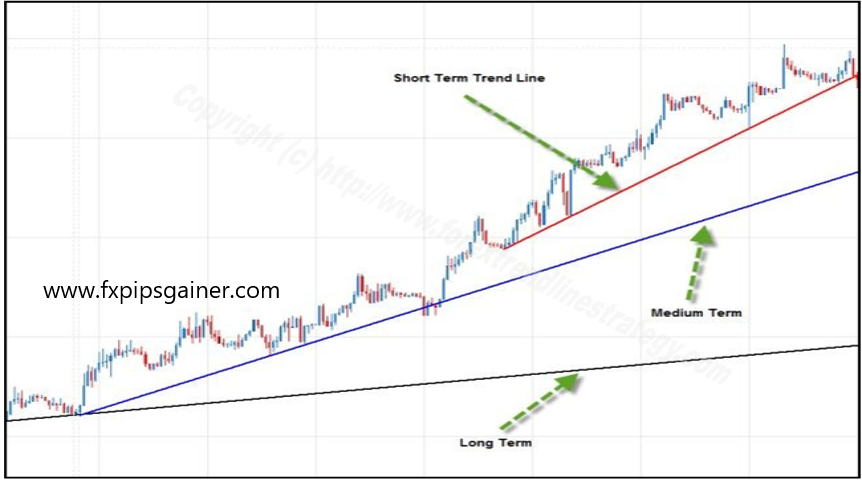

The short term trend line is the most recent trend line and you will be using it to trade most of the time.
Some of we may think that the long term trend line must be drawn from a higher time frame and short term trend line is drawn on a lower time frame. In fact, all the long to short term trend lines are drawn on the same chart.
The difference between the various types of trend lines lies in the number of candlesticks or period that the line passes through. For long term trend line, it has to be drawn over a longer period of time while the short term trend line is usually drawn over a shorter period of time.
As for the period to draw, there is no specific guideline we should follow.
Rules for Conventional Trend Line
- The Best Trend Line Is One That Connects The Most Swing Highs or Lows.
- Once The Support Trend Line Is Broken, It Will Turn Into Resistance Trend Line.
- Once The Resistance Trend Line Is Broken, It Will Turn Into Support Trend Line.
Trade Now
Steps to Drawing our 3 Types of Conventional Trend Line
Step 1: Shrink our selected time frame to a smaller size until we see the start of our current trend. If the currency pair we are trading is currently in an up trend, we simply have to shrink our chart until we can see the beginning of the up trend.

Step 2: If WE are in a down trend, look for major swing highs and if WE are in an up trend, WE should look at the major swing lows. (To draw a strong trend line, WE need to have at least 3 points of contacts which means that we need at least 3 swing highs or lows).
Step 3: Connect at least 3 swing highs or swing lows to form your long term trend line.
Step 4: Expand our selected time frame and look for major swing high or low after the last point of contact for the long term trend line.

Step 5: Connect those swing highs and lows that we have found in step 4 and we will get our medium term trend line.
Step 6: Look at our recent candlesticks and draw the necessary trend line and that will be our short term trend line.

Trade Now
[…] How To Draw Conventional trend Line […]